Decisions Have No Autopilot
AI doesn't replace organisational judgement — it amplifies whatever decision-making culture already exists.

At just before half past two in the morning on 1 June 2009, three pilots with more than 20,000 hours of combined flying experience were at the controls of Air France Flight 447, cruising over the Atlantic on autopilot. When ice crystals blocked the plane's speed sensors and the autopilot disconnected, the aircraft asked its pilots to do the one thing they had stopped practising: fly it themselves.
They disagreed about what the instruments meant, corrected against each other, and ran out of altitude before they ran out of confusion. The automation hadn't failed. The judgement underneath it had gone soft, and nobody noticed until it was needed.
Organisations are doing something similar with AI, at lower stakes and much greater speed.
One of the first questions we ask new clients is "how do you make decisions?"
It's an important question. A group of people, however they're organised or structured, that doesn't know how it makes decisions will struggle to move forward. Some organisations implicitly or explicitly defer to whoever is most senior. Others believe they operate by "consensus". Increasingly, though, organisations are letting AI make decisions for them, and hiding the fact that they've done so.
There's nothing wrong with using AI to do your work. FIELD STATION builds and analyses things using AI; this piece was improved with AI assistance. But at some point a line gets crossed: the point where "efficiency" or "augmentation" becomes the reduction of a capacity to decide.
We investigate the future of work, technology, and society, so this matters to us.
Judgement distortion at scale
A recent essay argued that some organisations are suffering from "AI mania", which distorts judgement rather than providing clarity. Plenty of individuals and organisations are getting real value from LLMs and AI agents in their workflows. We'd argue that's because they already know how to make decisions. It's easier for individuals to use AI well: they don't have to coordinate with anyone else before doing it. Organisations that aren't already good at coordination and decision-making tend to find AI more of a hindrance than a help.
Rather than the cognitive surrender some commentators describe, what's happening looks closer to an abdication of judgement. That's not new. Wanting someone, or something, to decide for you is a very old impulse: it relieves you of responsibility and gives you somewhere else to point when things go wrong.
AI doesn't change what's already there; it turns the volume up on it. Organisations that are already good at decision-making get better with AI. Processes speed up, and agents can run in loops on top of an already-shared understanding of what matters.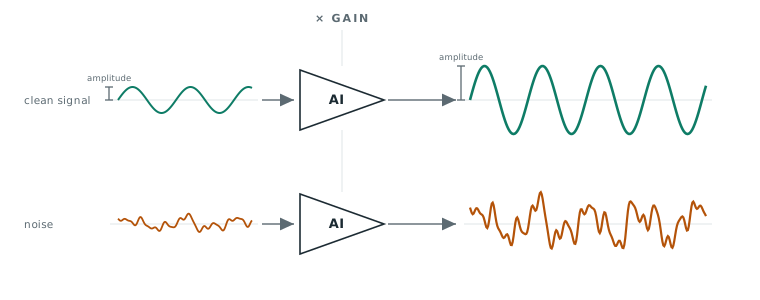
Push a small, clean signal through a gain stage and it comes out bigger, but still clean. That's what AI does for organisations that already know how they decide.
Organisations that aren't good at decision-making get a rougher deal. With no shared structure to defer to, individuals abdicate judgement to whichever AI tool they've adopted as shadow IT. In meetings, everyone may be working from a different LLM's version of the truth, each pulling in its own direction.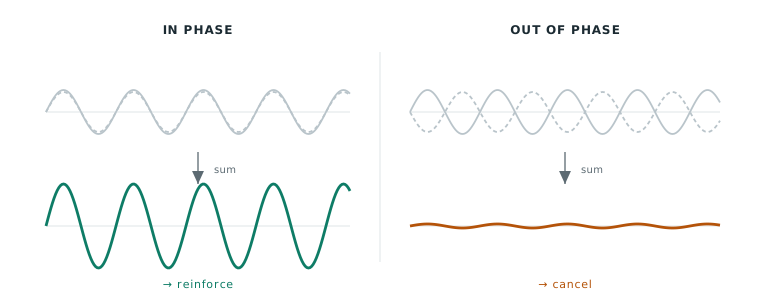
Push noise through the same gain stage and it comes out bigger too, just louder and no clearer. Two signals in phase reinforce each other; two signals out of phase cancel out. A room full of people, each briefed by a different model, is closer to the second case.
No wonder some organisations struggle. The essay mentioned above cites one consultancy's own client work: across 18 months and roughly 300 conversations, they observed a 0% success rate on enterprise AI projects. It's worth being precise about what that figure is: one practice's anecdotal, unaudited sample, not a controlled study.
It's in the same territory as MIT's 2025 review of 300 public AI deployments, which found 95% delivered no measurable financial return, a figure MIT's own researchers describe as directional rather than audited. Neither number should be read as a global verdict on the technology. Read together, though, they point at the same pattern: hype, marketing, and general zeitgeist alone don't explain why so much money and time is going in without much coming out.
Our answer: AI acts as a resonator. For organisations good at deciding, it produces a stronger, clearer signal. For organisations that struggle to pass truth up the hierarchy, and rely on ritual rather than reasoning, it just adds speed and cover: more artefacts, produced faster than anyone can check them, more noise, less clarity.
Intentional decision-making
Every organisation has processes, however large or small. In established organisations these run through committees, delegated authority, and named owners for projects and programmes.
In practice, decisions often happen for reasons that have little to do with any of that: moods, timing, risk tolerance, status, and who tells the most convincing story about "reality" in a meeting. It's worth naming this openly, since AI slides into exactly this gap between what an organisation tells itself and how it actually works.
AI systems tend to arrive in the name of efficiency, with no check on whether they add effectiveness. In organisations that are already poor at deciding, they usually just swap one opaque system for another: this one more confident-sounding, no less opaque.
This is where sovereignty comes in, and not as a tangent. In The Sovereignty Stack Has No Bottom, we argued that sovereignty isn't a final state you reach once, since every layer of the stack conceals another layer beneath it. Decision-making works the same way: there's no dashboard, model, or governance layer that removes the need for people to understand what they're doing and why.
Whether it's a council service, a university support system, a bank's lending decision, or a hospital triage workflow, the live question isn't whether the AI is accurate enough. It's whether the organisation can still reason together about what it's doing, or whether that capacity has been handed to an algorithm owned by someone else.
The evisceration happens slowly, then all at once, as it did on Air France 447.
Decision sovereignty
Technical sovereignty matters to us; it's why we started TechFreedom. But it isn't sufficient on its own. An organisation can self-host its LLMs, control its own data, satisfy every compliance requirement, and still surrender its judgement.
People need to be able, willing, and explicitly authorised to challenge a system's output. No organisation can outsource how it defines a problem, sets its constraints, or weighs a recommendation. Automation is valuable; accountability still has to sit somewhere. A widely circulated 1979 IBM training slide put it bluntly (its exact origin is hard to pin down, but the line has stuck for a reason):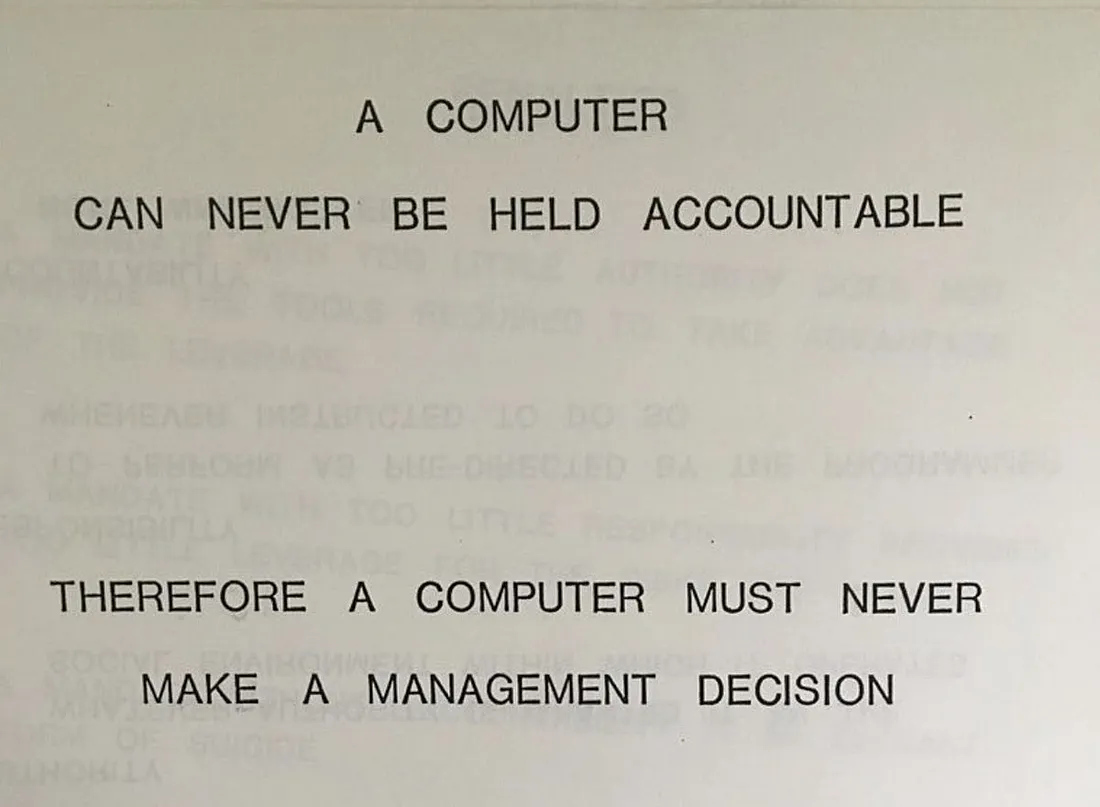
LLMs are good at confident narration. That's not the same as being good at deciding. They can play a role in decision-making, but sovereignty over the decision itself has to stay with the organisation. Most of work and life is ambiguous, and that's exactly where these tools are weakest.
Where they do help is pattern-spotting, synthesis, drafting, and generating scenarios; they're generative tools. What they cannot carry is political accountability, organisational memory, or moral responsibility.
Cognition isn't just plausible text. Neither is organisational judgement. It's interpreting data and scenarios with consequences attached, and living with the result.
The same ratio we described for technical sovereignty applies here. A ministry that has migrated its infrastructure but still buys its energy from someone else's grid isn't zero-sovereign or fully sovereign, it sits somewhere on a ratio. An organisation is in the same position with its decisions: what proportion of them are actually reasoned through by people who can be held to account, versus delegated to a tool nobody chose to authorise?
So what do we do about this?
Long before AI arrived, organisations had already confused work signalling with the work itself. Much of what passes for "productivity" is really reassurance that something is happening, in what we might call maintenance loops: meetings, presentations, status updates. Lots of activity, lots of energy, and not much movement. Reports about reports, meetings about meetings, an organisation's own output reflecting back on itself.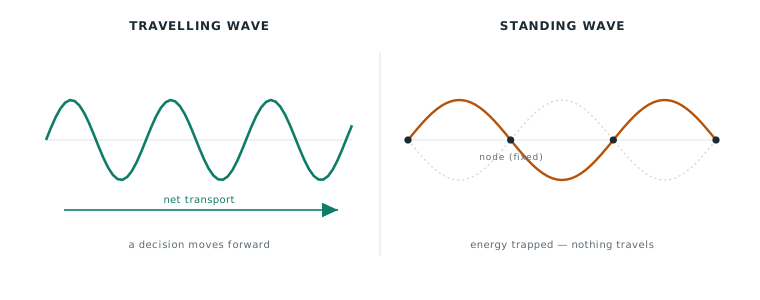
A travelling wave carries energy from one place to another. A standing wave pumps in place, fixed at both ends, moving nothing anywhere. Maintenance loops are standing waves: plenty of visible motion, no transport.
AI makes it easier than ever to produce the artefacts these loops run on, which lets an organisation feel maximally reassured that progress is happening while nobody actually decides anything. The goal isn't a more convincing plausibility machine. It's impact.
Impact comes from making decisions, repeatedly. Getting better at making decisions comes from making them often, not from handing them off. AI and automation aren't "good" or "bad" in themselves, they're a mirror of whatever an organisation is already good, or bad, at.
Meetings were never the work. Slide decks were never the work. Deciding is the work, and it's the part that AI mania is turning down.
If FIELD STATION can help your organisation see how many of its decisions are actually being made, and by whom, get in touch.